 Way Makers Journals
Way Makers Journals
Way Makers Journals
Our peer review process is designed to protect academic quality, editorial fairness, and research integrity through a structured workflow from submission to publication.
A strong peer review system builds credibility for authors, confidence for readers, and long-term quality for every journal issue. This redesigned page keeps your original workflow but presents it in a more modern and professional format.
Every submission goes through an editorial review to assess scope, structure, ethics, and general suitability.
Qualified reviewers evaluate originality, relevance, clarity, methodology, and overall scholarly contribution.
Reviewer and author identities remain concealed to promote fairness, neutrality, and unbiased academic assessment.
Editors make the final decision after considering reviewer comments, revision quality, and compliance with journal standards.
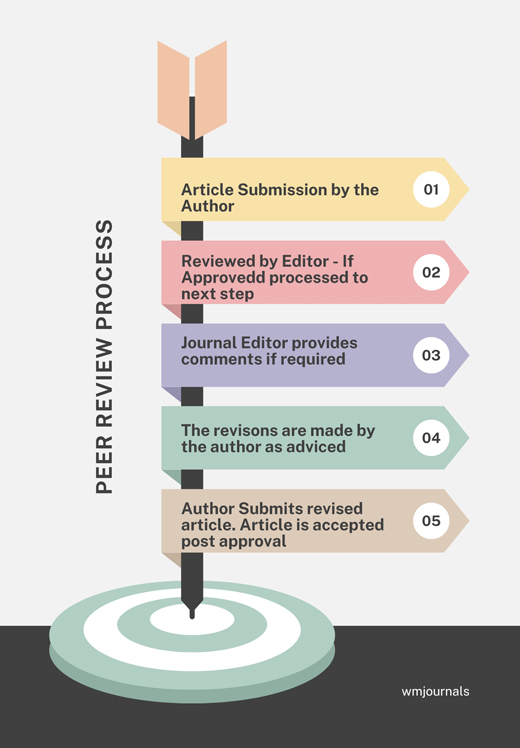
The editorial process follows a sequence of clearly defined stages. This structure helps maintain consistency, transparency, and efficiency while protecting the academic standards of the journal.
We emphasize confidentiality, ethical screening, constructive reviewer feedback, transparent editorial judgment, and timely communication with authors throughout the process.
Authors submit manuscripts through the online submission system along with the required files and publication details.
The editorial office checks the manuscript for journal scope, formatting, originality expectations, policy compliance, and ethical readiness.
Suitable subject experts are identified and invited to review the manuscript based on discipline relevance and academic expertise.
The manuscript is evaluated under a double blind model in which author and reviewer identities remain hidden during the review cycle.
Reviewers provide comments, recommendations, and observations related to originality, structure, scientific contribution, and clarity.
Authors revise the manuscript in response to reviewer and editor comments, then resubmit the updated version for further assessment if needed.
The editor issues a final decision such as acceptance, revision request, or rejection after carefully reviewing all evaluation inputs.
Accepted articles proceed to final processing and publication so that the research becomes available to the broader academic community.
Our peer review model is structured to ensure fairness, confidentiality, rigorous evaluation, and editorial consistency across every manuscript handled by Way Makers Journals.
These quick answers help authors understand how the review pathway works before submitting a manuscript.
Yes. The process is designed so that author and reviewer identities remain hidden during the main evaluation stage.
Yes. Authors may be asked to revise the manuscript based on reviewer and editorial comments before a final decision is made.
The editor makes the final decision after considering reviewer reports, manuscript quality, revisions, and journal policy requirements.